Concept | AI-native prosumer productivity (agentic, human-in-the-loop)

Role
Concept | Product design | AI interaction
Timeline
2026 | Self-directed concept
Stack
Space Grotesk + Inter + IBM Plex Mono | single amber accent
Platform
Web + mobile
Context
A self-directed concept built to close a specific hole in my portfolio: every existing piece is web, desktop, or print and analytical or brand-led. Nothing shows the frontier skill hiring managers screen hardest for in 2026, designing trust, provenance, and human control for a generative, agentic system. Understudy is that piece, framed honestly as a concept with no client and no invented outcome metrics.
Problem
Agentic assistants split into two failure modes. One over-automates: it acts on your behalf, quietly, and you find out after the fact, so trust collapses on the first mistake. The other under-designs: it dumps raw model output into a chat window with no sources, no confidence, and no way to steer, so the human stays the bottleneck. The real design problem is to give a solo operator genuine leverage while keeping a visible, revocable gate between the model’s intent and the real world, and to make the model’s work legible enough to approve in seconds, not minutes.
Approach
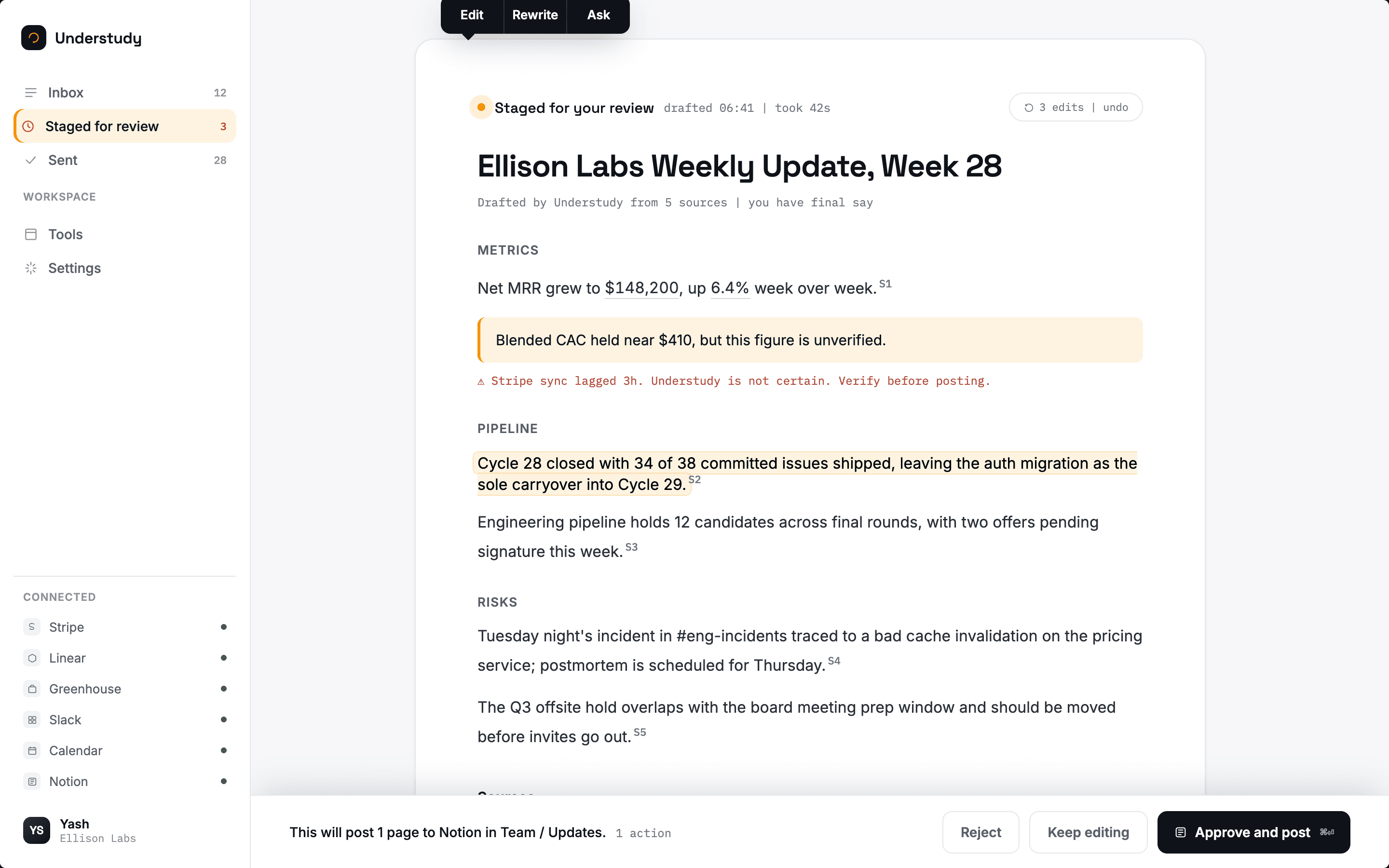
I designed around a single load-bearing idea: staging. Understudy never touches the outside world by default. It drafts, it plans, it stages, and then it stops at an explicit approve or reject gate. Four systems carry that idea. A plan-then-act view exposes the agent’s steps as legible, interruptible text instead of a spinner. Provenance is treated as receipts, every claim the agent makes carries a source chip you can open. Confidence is a calibrated three-tier signal, never a false-precision percentage. And a single electric amber accent is rationed to mean exactly one thing, this needs your hand, so the eye travels only to where a decision is actually owed. Kinetic typography carries the state change from Drafting to Staged to Sent, so motion reads as the system thinking rather than as decoration.
Outcome
A concept case study, not a shipped product. The deliverable is a coherent ‘calm command’ design world across responsive web and a companion mobile surface, expressed as four key screens with full build specs. Its job in the portfolio is evidence of judgment on the hard AI-UX problems, plan transparency, provenance, calibrated confidence, editable drafts, undo, and an explicit human gate, in a light, architectural register that is visibly distinct from both the dark chrome of the rest of the roster and the warm, earthy register of the companion concept.
Decisions | Reasoning


Results
A concept, not a shipped product: four full-spec screens built to demonstrate judgment on hard AI-UX problems like transparency, confidence, and human control.
Next project